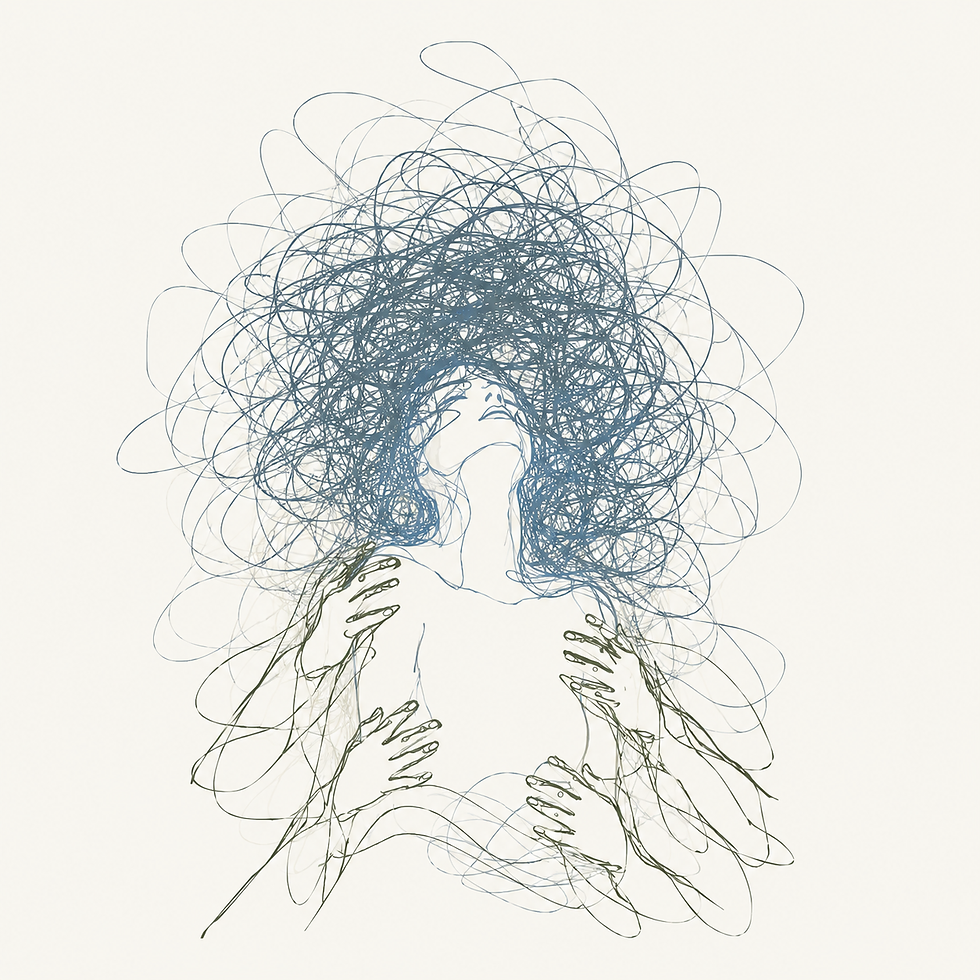
The Cycle That Keeps You Stuck (and How CBT Breaks It)

Updated: Aug 31
Cognitive Behavioural Therapy (CBT) is generally the most widely known and practiced form of psychological treatement, and often the first one people encounter when they start looking into psychological support. It has a large evidence base across a wide range of presentations (e.g., anxiety, depression, behavioural-modification), and tends to be goal-focused, structured, and relatively time-efficient compared to some other approaches.
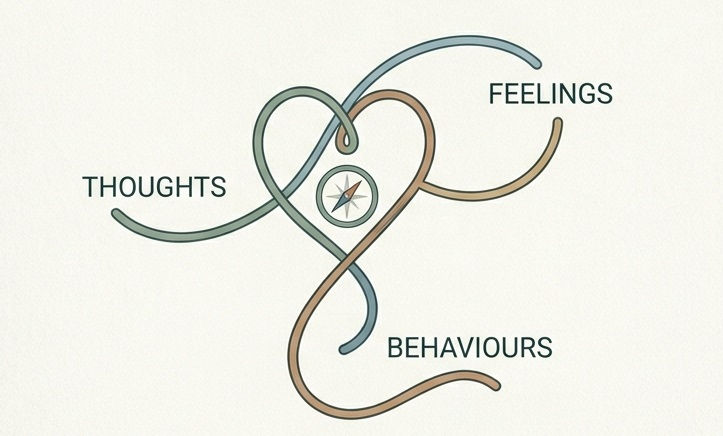
The cycle CBT works with
CBT is built on a fairly simple observation, that thoughts, feelings, and behaviours are all connected, and each one influences the others. For example, a thought such as "I am going to embarrass myself" tends to produce hestitation, doubt, and anxiety, which then makes avoidance feel like the safer option. That avoidance, in turn, keeps the original thought untested, and the acton of avoidance often reinforces the original idea ("I am going to embarrass myself").
CBT is essentially a way of interrupting this cycle, by working with and modifying the thought, the feeling, or the behaviour associated with a problem. The choice depends on the goal and which point presents as the most effective target to reach that goal.
Testing thoughts against evidence
One of the central techniques in CBT is cognitive restructuring, which involves identifying a thought, examining whether it is a rational or helpful thought, and considering whether there is a more accurate way of thinking about the situation. This is not about replacing a negative thought with a falsely positive one (e.g., "everything will be ok"), and it is not about "thinking positively." If someone thinks "I always fail at this," the aim is not to insist otherwise, but to look at the actual evidence; has this been true every time, and what does the evidence really show?
The purpose of this is not to arrive at a fixed, correct answer, but to loosen the automatic grip a thought can have. Once a thought is treated as something that can be examined and questioned, rather than something that is always true, it tends to carry less weight, and the emotional and behavioural reactions that follow from it (such as avoidance) tend to soften as a result.
Working with behaviour directly
Because thoughts and behaviour influence each other in both directions, CBT also works directly with behaviour, rather than only with thinking. Behavioural activation involves gradually reintroducing activities that have been dropped, often due to low mood or avoidance, since withdrawal tends to reinforce the very thoughts and feelings it was meant to protect against.
This matters because some patterns are more efficiently changed through action than through thought alone. Waiting to feel motivated before acting often means waiting indefinitely, whereas testing a prediction directly, by doing the thing and observing what actually happens, tends to shift the underlying thought more quickly.
Exposure-based work
For difficulties involving significant avoidance, such as phobias, panic, or social anxiety, CBT often draws on exposure-based techniques. This involves gradually and deliberately approaching feared situations in a structured, paced way, rather than avoiding them, so that the prediction driving the fear can actually be tested rather than assumed, and eventually for the fear to be extinguished.
What a course of CBT tends to look like
CBT is usually structured around a specific, agreed goal, with progress tracked over the course of therapy. Sessions often include reviewing what has changed since the last appointment, working on a particular pattern, and agreeing on something to practise in between sessions. This is a more directive and structured style than some other therapeutic approaches, which some people find useful and others find less suited to how they prefer to work.
Who this tends to suit
CBT has a strong evidence base for depression, anxiety disorders, and a range of other presentations, and it tends to suit people who find a structured, skills-based approach useful, particularly where specific thinking patterns or avoidance are maintaining the difficulty. It is not the only effective approach, and for some presentations, particularly more complex or longstanding difficulties, a different approach, or a combination of approaches, may be more appropriate. This is worth discussing directly with a psychologist as part of working out what fits your situation.
Resilient Path Clinical Psychology is a private practice located on Toorak Road, on the Camberwell-Burwood border, offering therapy for adults, adolescents, and couples, available in-person and via telehealth. Serving Camberwell, Burwood, Ashburton, Glen Iris, Surrey Hills, Canterbury, Balwyn, Mount Waverley, Glen Waverley, Box Hill and surrounding areas. Medicare rebates available with a Mental Health Care Plan. If you have questions about getting started, you are welcome to get in touch.